USE BY THE FACILITATOR
While using the LIVING MOODBOARD tool, facilitators play a discreet and enabling role. Their task is not to direct the moodboard composition, but to create conditions that allow learners to freely explore their own living imagination through images, colours, and materials.
The role of the facilitator is to prepare all necessary materials; introduces the task clearly yet evocatively, linking it to previous activities; encourages learners to choose what visually represents their own desires and preferences, without imposing aesthetic or functional pressure; and facilitates the final reflection, helping learners make sense of the outcome without imposing interpretations.
The key focus is on supporting the process rather than judging the final product. Each collage is an expressive act, with every combination revealing aspects of the learner’s experiences, preferences, and desires. The facilitator’s role is to help this narrative emerge naturally and safely, highlighting the uniqueness of each individual.
LIVING MOODBOARD is an intuitive, accessible, and creative tool, designed for independent use or to be used with light guidance. Learners are invited to build a personal moodboard reflecting the space they would like to inhabit, or, if provided with a brief, to imagine the space for another person.
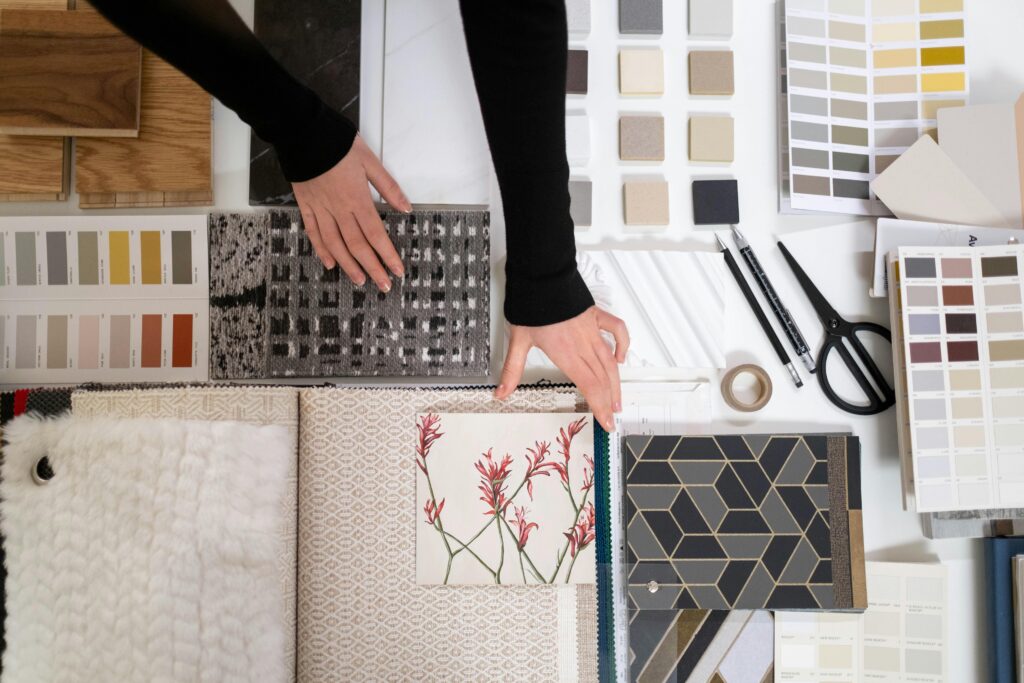
During the activity, they are invited to:
- freely explores the available materials (images, cut-outs, fabrics, papers, colours, textures…);
- think about their own needs or, if working from a brief, empathises with the needs of the potential inhabitants of the space, acknowledging and valuing the requirements relevant to that scenario;
- selects elements that resonate with their own lived experience, tastes, or aspirations;
- composes a visual board by gluing, layering, or arranging elements on the printed template;
- assigns meaning to their selections, either freely or through guided prompts (keywords, titles, comments, sensations).
This activity:
- helps translate emotions, memories, and desires into a tangible form;
- stimulates intuition and awareness of spatial preferences;
- facilitates non-verbal communication, especially useful for participants facing some participation or communication barriers;
- creates a bridge between experiences explored in previous modules and the future design of real spaces.
At the end, learners may share their moodboards to express themselves, or, if applicable, contributing to participatory design of environments that reflect the identity of the person described in the brief.

Made with love by Wellhome team
Funded by the European Union. Views and opinions expressed are however those of the author(s) only and do not necessarily reflect those of the European Union or the European Education and Culture Executive Agency (EACEA). Neither the European Union nor EACEA can be held responsible for them.