
Exercise 1 – From Insight to Object
- Learners choose one key insight from previous modules – something they observed about themselves, other users, or the space. This could be:
- An emotion that a space should evoke (e.g., calm, stimulation, comfort).
- A routine or activity that takes place in the space (e.g., preparing meals, studying, socialising).
- A colour or material preference identified in the Language of Colour module.
- A sensory or accessibility need (e.g., soft textures, clear orientation, tactile cues).
Step by step, learners then:
- Identify the need or feeling they want to respond to;
- Decide on a type of object that could support or express that need (e.g., a storage box, a seating element, a visual marker, a tactile panel);
- Sketch a simple version of the object on paper, focusing on function, size, and placement rather than artistic detail;
- Consider how the object might interact with the space and the people using it.
This approach makes the connection between insight, object andspatial impact explicit.
Exercise 2 – Customisation through Making
In this phase, learners transform their sketched idea into a tangible object using the available tools and materials.The goal is not technical perfection, but to translate intention into physical form.
Facilitators guide the process step by step:
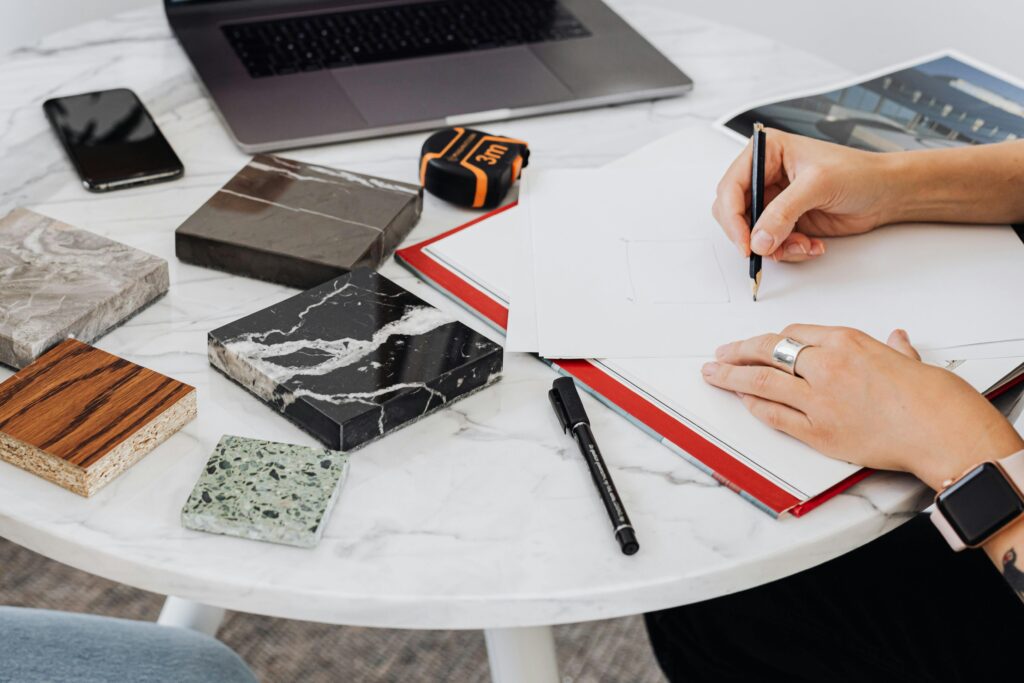
Step 1 – Select Materials
Participants choose materials that reflect the function and feeling of the object.
Facilitators may prompt them to consider:
- Should the object feel soft, solid, light, or protective?
- Does the material need to be durable or temporary?
- Does colour play a role in reinforcing the intended atmosphere?
- Material selection should connect clearly to the insight identified in Exercise 1.

Step 2 – Construct the Basic Structure
Participants begin building the main structure of the object through:
- cutting components,
- assembling parts,
- fixing or joining materials.
Facilitators should:
- demonstrate safe tool use;
- break complex tasks into manageable actions;
- support participants who may feel insecure using tools;
- encourage collaboration when appropriate.
This phase focuses on establishing function and stability.
Step 3 – Customise and Refine
Once the basic structure is completed, participants personalise the object through:
- colour application (paint, markers, vinyl, etc.);
- adding tactile elements (textiles, cork, rope, padding);
- integrating symbolic or identity-based details;
- adjusting proportions or positioning.
Facilitators should encourage reflection during this phase:
- Does the object still respond to the original need?
- Does it feel coherent with the intended atmosphere?
- Is it comfortable and usable?
Small modifications are encouraged. Iteration is part of the learning process.

Step 4 – Test and Position
Participants briefly consider where and how the object would function in a real space.
Facilitators may ask:
- Where would this object be placed?
- Who would use it?
- Does it improve the spatial experience?
This step reinforces the connection between object-making and spatial design.
Step 5 – Present and Reflect
Participants present their object and explain:
- the insight it responds to;
- the choices made in materials and form;
- how it could be integrated into a renovation or co-design project.
Facilitators should guide reflection toward learning outcomes rather than aesthetic judgement.
Why is this a key tool in the design process?
This module is a key tool because it connects insight, creativity, and spatial impact in a tangible, hands-on way. It allows learners to move from ideas to real objects that can influence how a space is experienced.
This activity is particularly important because it:
- Transforms abstract insights into concrete solutions: Learners take emotions, routines, colour choices, or sensory needs identified in previous modules and turn them into physical objects.
- Supports inclusion and participation: Making is accessible at any skill level. Everyone can contribute, experiment, and see their ideas realised, regardless of prior experience.
- Encourages iterative thinking: Learners can test, modify, and refine their objects as they work, learning how small changes affect function, usability, and perception.
- Strengthens spatial awareness: Objects are designed with placement, function, and human interaction in mind, linking making to real-life renovation and co-design projects.
- Promotes collaboration: Working together encourages sharing of ideas, problem-solving, and peer learning, reinforcing group cohesion and communication.
- Highlights adaptability over technology: Whether using simple hand tools or basic digital fabrication, the value comes from intention, creativity, and responsiveness to real needs –
- not machinery.
- Builds confidence and empowerment: Completing an object from concept to execution demonstrates that learners can make meaningful contributions to a space, enhancing their self-efficacy in design contexts.
By embedding these principles, the module reinforces a human-centred, inclusive approach to spatial design, showing facilitators and learners alike that meaningful interventions are possible even in low-tech, constrained, or fragile environments.
Adaptable, scalable, and connected to lived experience
This module is designed to be flexible and inclusive, allowing facilitators to adjust the activities according to the group, the space, and the available tools. Whether working with simple hand tools, recycled materials, or basic digital fabrication devices, the exercises can be tailored to different levels of complexity and learner experience. The process can be scaled to fit a single workshop, a series of sessions, a small group, or a larger team, without losing its focus on meaningful engagement.
What makes this approach particularly powerful is its grounding in lived experience. Learners are encouraged to base their designs on real needs, routines, emotions, and preferences – whether their own or those of the people who will inhabit the space. The objects created are not abstract or decorative; they emerge from observation, reflection, and empathy, responding to actual spatial and functional requirements. In this way, the activity connects making to real life, showing that design can be inclusive, participatory, and responsive, even in low-tech or resource-limited contexts.
By combining flexibility, scalability, and a direct connection to human experience, the FABLAB & CUSTOMISATION module reinforces a practical, hands-on approach to design where every participant can contribute, experiment, and see the tangible impact of their work in the spaces around them.

Made with love by Wellhome team
Funded by the European Union. Views and opinions expressed are however those of the author(s) only and do not necessarily reflect those of the European Union or the European Education and Culture Executive Agency (EACEA). Neither the European Union nor EACEA can be held responsible for them.